
In a wholesale custom fragrance project the scope decides the price, not the other way round, and a festive gifting range makes that plain because timing and packaging both sit inside the scope. A buyer who settles six items before requesting a number — format, scent direction, pack configuration, artwork ownership, delivery window and repeat volume — receives quotes that can honestly be compared. A buyer who does not receives a number that is really an assumption, and assumptions are what get renegotiated in October. The checklist below is written for the person who has to defend that number internally.
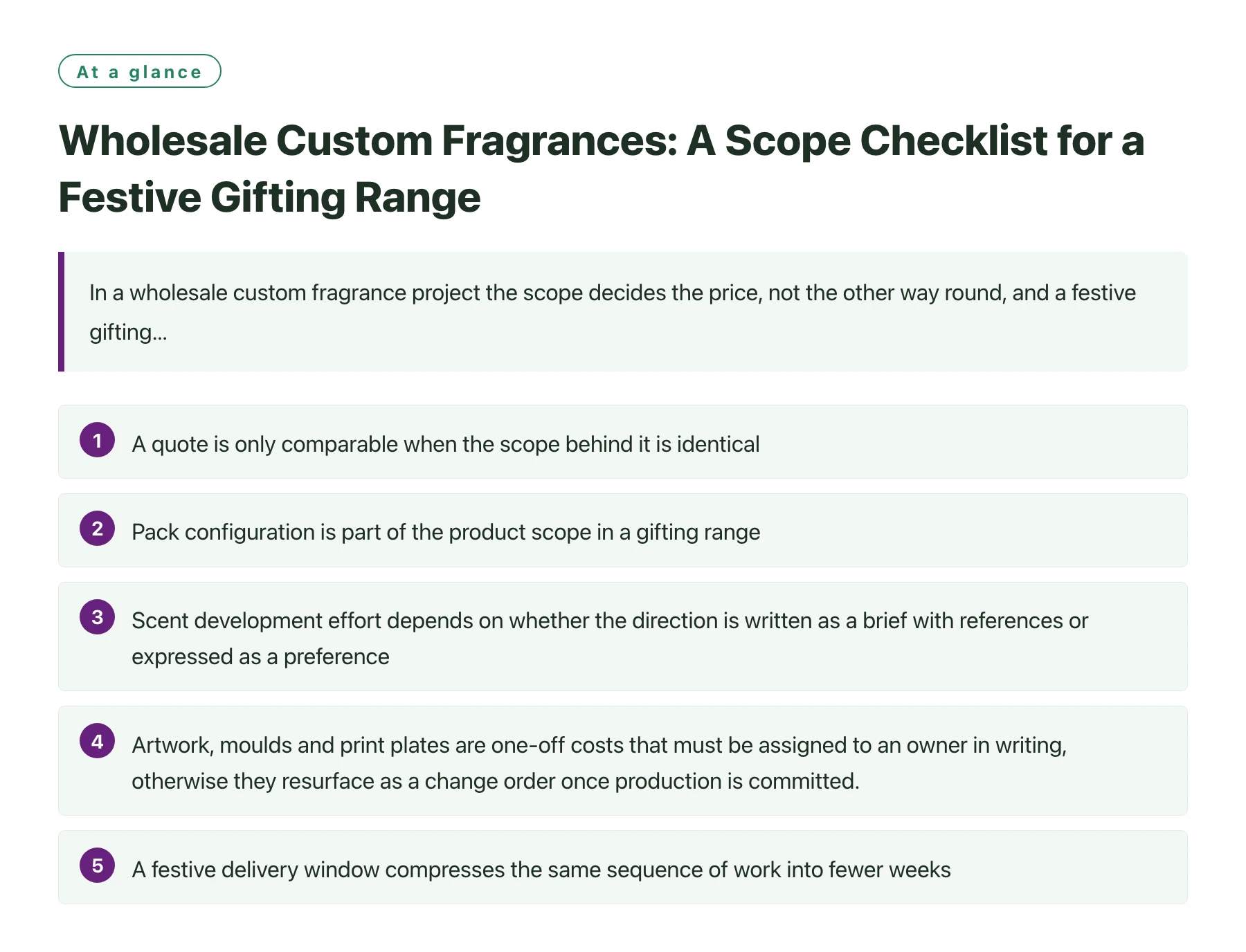
Key takeawaysA quote is only comparable when the scope behind it is identical, so the scope document should exist before the first supplier conversation rather than after the third. · Pack configuration is part of the product scope in a gifting range, not an afterthought, because set assembly and outer cartons carry their own minimums and lead times. · Scent development effort depends on whether the direction is written as a brief with references or expressed as a preference, and that difference is visible in the sample rounds. · Artwork, moulds and print plates are one-off costs that must be assigned to an owner in writing, otherwise they resurface as a change order once production is committed. · A festive delivery window compresses the same sequence of work into fewer weeks, which changes both the cost profile and the risk of air freight. · Testing and documentation obligations belong in the scope as line items with a named format and language, not as a general promise of compliance support.
Most arguments about fragrance pricing are not arguments about price. They are arguments about scope that were deferred until the moment money had to be spent. A gifting range exposes this faster than a core line, because a gift set is several products pretending to be one, and each of those products has its own minimum, its own artwork and its own lead time.
The practical reference for how wholesale custom fragrances projects move from brief to bulk is worth reading first, because this article assumes that sequence and only deals with the commercial decisions laid on top of it. Nothing here is specific to one supplier; the aim is a scope document you can hand to two factories and get two comparable answers back.
The six scope items to settle before anyone quotes
| Scope item | What to pin down | Why it changes the number |
|---|---|---|
| Product format | Whether the range is fine fragrance, home fragrance or a scented body product, and in which sizes | Filling, labelling, testing and stability expectations differ by format, so one scent can carry three different cost structures |
| Scent direction | A written brief with reference materials, or a choice from an existing library of directions | A new formula consumes development time and sample rounds; adapting an established direction usually consumes fewer |
| Pack configuration | Whether a gift is a single bottle, a bottle and carton, or a multi-item box with an insert | Set assembly, inserts and outer cartons are separate operations with separate minimums |
| Artwork and ownership | Who supplies artwork, who owns moulds, plates and design files, and who pays for changes | Tooling and print setup are one-off costs that have to sit with someone |
| Delivery window | The date goods must be in your warehouse, not the date the purchase order is issued | A festive window fits the same work into fewer weeks and can force a faster, dearer route |
| Repeat volume | First order quantity plus an honest view of whether a second order will follow | A first order priced with no repeat view is priced alone, and priced accordingly |
Read that table as a set of owners rather than a menu. Every row is a decision that somebody has to own, and any row left unowned becomes a change order later, which is exactly where the festive calendar has no slack. When two suppliers return numbers that differ by a wide margin, the difference is almost always sitting in one of these six rows rather than in some abstract measure of factory efficiency. Comparing perfume unit cost structures line by line is the only way to see which row moved.
What a festive gifting range adds that a core line does not
A core line can absorb a two-week slip without anyone outside the company noticing. A gifting range cannot, because the shelf date is fixed by a holiday that will not move. That single fact changes how the scope should be written: dates stop being targets and become constraints that decide which options are even available.
There is also a compliance dimension that buyers often discover late. Fragrance materials are governed by published standards and restrictions, and those standards apply to a gift set exactly as they apply to a standing product, even if the set is sold for a season and then withdrawn. [1] A supplier who treats a seasonal line as exempt from the same documentation is telling you something about how the rest of the work will be handled.
Timing compresses the sample loop rather than the production run
When a deadline tightens, buyers instinctively ask for a faster production run. In practice the production run is rarely the flexible part. The sample loop is, because it is the stage where feedback rounds and reformulation happen, and every additional round consumes weeks. If the calendar is short, the useful lever is the quality of the first brief and the discipline of the review — one round with three consolidated comments beats three rounds with one comment each.
This is also where the cost of a rushed gifting range hides. Compressing the sample loop is free if the brief is good, and expensive if it is not, because the fallback is approving a sample that is merely acceptable and then paying for it in returns.
Set assembly creates a minimum of its own
A gift set is not a bottle with a box around it. Someone has to assemble the components, place the insert, close the carton and shrink-wrap or seal the unit, and that assembly step has a minimum quantity that is separate from the filling minimum. Buyers who only ask about the liquid minimum are surprised when assembly turns out to be the binding constraint.
The same applies to documentation for the carton itself. Packaging rules in major markets increasingly treat the outer box as part of what the buyer is responsible for, including recyclability expectations and the amount of material used. [2] If your festive set ships into those markets, that obligation belongs in the scope at the point where pack configuration is decided, not in a compliance review after artwork has been signed off.
How to run the scope conversation without losing the timeline
Send the same written scope to every supplier you are considering, in the same order and with the same level of detail. The value of a standard scope is not fairness for its own sake; it is that a supplier reading a complete document will price the whole job, while a supplier reading a partial one will price a plausible subset and leave the rest to be discovered later. Include the verification step: independent laboratory testing is a separate item on the calendar from factory release, and it is worth agreeing who commissions it and how many working days it needs. [3]
Where a job spans formulation, filling, assembly and packing, it is worth knowing how much of that a single partner actually runs one-stop fragrance manufacturing rather than coordinates, because the answer decides how many conversations you are managing in the final six weeks. A handover between two partners adds a step that a tight calendar may not have room for.
Ask for previous work in the same shape as yours — a gifting range with multiple components, not a single-bottle line. Looking at examples of fragrance projects of comparable complexity tells you more about a supplier's assembly discipline than any description of capabilities, and it gives you a specific question to ask: how many components in that set, and who held the tooling.
Finally, write the scope into the purchase order as an explicit list, including which decisions are frozen and what happens if one has to change. The list is short, boring and the single most effective protection you have against a festive timeline that quietly becomes a January delivery.
One practical habit: number the scope items and put those numbers on every drawing, artwork file and email subject line from the first day. When a supplier writes back about item four, you know instantly that they are answering the question you asked rather than a question they assumed. Teams that do this report far fewer instances of two departments inside the same factory working from two different versions of the same brief.
Sources
- IFRA Standards Library (International Fragrance Association) —— The IFRA Standards Library lists the restrictions the fragrance industry applies to individual fragrance ingredients, based on safety assessments; it is the reference point for compliant fragrance formulation.
- European Commission: Packaging Waste and the PPWR —— EU rules on packaging and packaging waste, including the Packaging and Packaging Waste Regulation requirements on recyclability and design.
- SGS: Cosmetics, Personal Care & Household Testing —— Testing, inspection and certification services for cosmetics and personal care, including microbiological, stability and safety testing aligned with cosmetics GMP.
Frequently asked questions
Should I share a target price with a wholesale fragrance supplier?
It is usually better to share the scope first and the target second, in that order. A target given before the scope invites a supplier to design a proposal around the number rather than around the product. A target given after the scope is useful information, because it lets them tell you which scope items to change rather than simply saying the budget is too low.
How early should a festive gifting range be scoped?
Work backwards from the date goods must be in your warehouse, then add the sample loop, documentation review and packaging print time before it. The predictable failure is buyers who start early enough for production and not early enough for approvals, so the compressed stage turns out to be review rather than manufacturing.
Does a seasonal gift set need the same compliance documentation as a standing line?
Yes. A fragrance material does not become less regulated because the finished set is sold for six weeks. The documentation should still identify the formulation, the safety assessment route and the responsible party, and the language and format should be agreed in the scope.
Why do two suppliers quote very different prices for what looks like the same gift set?
Because it is rarely the same gift set. One quote may assume an existing scent direction, a stock bottle and a simple carton, while the other includes a new formula, a custom mould and a printed insert. Put the six scope items side by side and the gap usually becomes visible without any need to question either supplier's honesty.
Who should own the moulds and artwork files?
The party who pays for them should own them, and that should be stated in writing along with the conditions for taking them to another supplier. Ambiguity here is expensive precisely because it only matters later, at the moment when the relationship is already under strain.